

7 Client Service Habits That Reduce Churn and Drive Referrals
Losing a client rarely comes down to only one thing. It’s the small things that add up. A slow response here, a missed expectation there, a conversation that felt more like a transaction than a partnership. Before long, the relationship quietly falls apart, and the client is gone before you even knew they were leaving.
The good news is that the same principle works in reverse. Small, consistent habits done well and done regularly are what turn a decent client experience into an exceptional one. And exceptional client service is one of the most powerful growth levers an Australian business has, especially for established service businesses in the $500K to $10M range, where referrals and retention drive most of the growth.
At Business Activators, we see the same pattern repeat: businesses that are technically good at what they do still lose clients because of how they show up in the relationship. The habits below aren’t complicated. What makes them powerful is consistency.
This article breaks down seven client service habits that reduce churn, drive referrals, and turn one-off clients into long-term partners, including why most businesses know these habits but struggle to practise them systematically.
Why Client Service Habits Drive Business Growth
There’s a reason the best businesses in any industry obsess over client experience. It’s not just good manners. It’s a good strategy.
Bain & Company research found that increasing client retention by just 5% can lift profits by anywhere from 25 to 95%. Think about that for a second. That’s not a marginal improvement from a minor operational tweak. That’s a fundamentally different business, built on the back of keeping the clients you already have.
And retention is only half the story. A 2025 Deloitte consumer loyalty survey found that 72% of consumers say loyalty programs make them more likely to spend with their preferred brand, and that up to 40% of a brand’s perceived value is driven by factors beyond price, including service quality and relationship. The clients who stay longest are also the ones who refer most freely, which means a better client experience compounds over time in ways that no marketing budget can replicate.
Most businesses know this in theory. McKinsey’s 2024 research on customer care found that only 8% of organisations in North America report greater-than-expected satisfaction with their customer service performance. The gap between what businesses think they’re delivering and what clients actually experience is where most of the churn quietly happens.
The businesses that achieve this aren’t always the biggest or the best-resourced. They’re the ones that are most deliberate about how they show up for clients, not just once, but every single time.
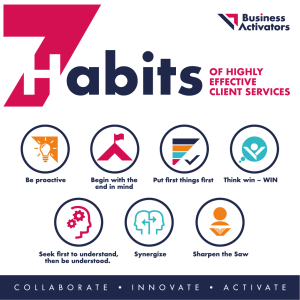
Habit 1: Be Proactive
Most businesses are good at responding to problems. Far fewer are good at preventing them.
Proactive service means staying ahead of your clients rather than constantly catching up. It means checking in before they have to chase you, flagging a concern before it becomes a complaint, and anticipating what they’ll need next rather than waiting to be asked. It sounds simple. But it’s genuinely rare, and clients notice.
The businesses that build proactive service into their operating rhythm stop spending so much time on relationship repair. They spend that time on value delivery instead, which is a far better use of everyone’s energy.
What proactive service looks like in practice: scheduled touchpoints that aren’t linked to an invoice or an issue; regular progress updates that keep clients across what’s happening; and early communication when timelines shift or risks emerge, even when that conversation is uncomfortable. Building these rhythms into your strategy implementation is what makes them stick across the whole team, not just the people who naturally think this way.
Clients understand that things don’t always go to plan. What they remember is whether you told them early or left them to find out for themselves.
Habit 2: Begin With the End in Mind
A lot of client relationships run into trouble not because the work is poor, but because both parties had different ideas of what success looked like. The client expected one outcome. You delivered another. Both parties feel aggrieved, even though neither was dishonest.
Beginning with the end in mind means getting specific about outcomes before the work begins. What does a successful engagement actually look like? What milestones matter? How will both parties know when the goal has been reached?
These conversations can feel awkward to initiate. But they prevent far more awkward conversations down the track. A client who feels aligned with you on outcomes from day one is a very different client to manage than one who’s quietly building a case against you.
How to put this into practice- at onboarding, define success in concrete and measurable terms. Write it down so there’s a shared reference point for both parties. Revisit it at key milestones to check alignment is still intact. When the destination is clear from day one, every decision along the way becomes a lot easier to make and a lot easier to defend.
This habit connects directly to strategic business planning; both are about building clarity before complexity sets in, not after.
Habit 3: Put First Things First
This habit is about working with intention. It means identifying the actions that create the most value for each client and protecting time for those, rather than letting the urgent crowd out the important.
Most service businesses have no shortage of things to do. The problem is that the loudest tasks tend to get done first, regardless of whether they’re the most valuable. An email that demands an immediate reply gets answered. A strategic review that could unlock a client’s next growth phase sits in the queue for weeks. Over time, this pattern quietly erodes the quality of your service without anyone realising it.
A practical way to build this habit is to maintain a simple priority framework for each client account. For every task, ask two questions: how much impact does this have on the client’s outcomes, and how urgent is it really? Plot tasks by those two dimensions and you’ll quickly see where effort is being misallocated. It takes less than fifteen minutes to do for any client account, and it changes how your whole team allocates effort across the week.
The businesses that do this well are the ones whose clients feel like they always get the best of the team, not just whoever is available. That’s a competitive advantage that’s very difficult to replicate.
Habit 4: Think Win-Win
The strongest client relationships are built on a simple foundation, and both sides feel like they’re getting a good deal.
That doesn’t mean giving everything away or agreeing to every request. It means approaching each engagement with genuine interest in the client’s success, not just in completing the work and closing the invoice. When clients sense that you’re invested in their outcomes, they invest back. They stay longer, refer more freely, and are far more understanding when things get complicated.
The contrast with other approaches is stark over time.
| Approach | Focus | Long-Term Outcome |
| Win-Win | Mutual value and shared goals | Loyalty, referrals, long-term retention |
| Win-Lose | Extracting maximum value per engagement | Short-term gain, high churn |
| Lose-Win | Agreeing to everything to keep the peace | Overservicing, margin erosion, resentment |
| No Deal | Walking away when the fit isn’t right | Protects both parties from a bad outcome |
Aim for win-win. And if that’s genuinely not possible, walking away cleanly is better than grinding through a relationship that doesn’t serve either party. A business that’s honest enough to say “we’re not the right fit for this” earns more trust than one that takes on every engagement and underdelivers on half of them.
Habit 5: Seek First to Understand, Then Be Understood
When a client raises a concern, the instinct is often to move quickly to solutions. To reassure them, explain what happened, or jump straight into fixing mode. That instinct, while well-meaning, often makes things worse.
Most service issues have a layer underneath the surface complaint. A client who says they’re frustrated with delays might really be worried about looking bad in front of their own stakeholders. A client who seems dissatisfied with the output might actually be anxious about a board presentation next week. Understanding that changes how you respond entirely.
This is one of the most underrated skills in client service, and one of the most trainable. It doesn’t require you to agree with the client’s position. It requires you to understand it fully before you respond. The discipline of asking one more question before moving to solutions is something that can be built into how your team handles every difficult conversation.
Clients who feel properly understood are significantly more patient, more loyal, and more likely to give you the benefit of the doubt when things don’t go perfectly. Building emotional intelligence habits into how your team communicates is one of the highest-return investments a service business can make.
Habit 6: Create the Conditions for Collaboration
The best outcomes in client work rarely come from one person working alone. They come from different perspectives, being brought together, tested against each other, and refined into something stronger.
In practice, this means two things. Within your own team, it means involving the right people rather than siloing information. The account manager shouldn’t be the only person who knows what’s happening with a client. When relevant expertise sits in different parts of your business, create the conditions for that expertise to reach the client’s work.
With your clients, it means treating them as active participants in the process rather than passive recipients of your recommendations. Clients who feel like genuine partners in the work are more invested in the outcome, more forgiving when things shift, and more likely to credit the success to the relationship rather than just the deliverable.
The human element in business is often the deciding factor in whether a technically good piece of work lands well or gets rejected, and collaboration is the habit that determines how that dynamic plays out.
Habit 7: Sharpen the Saw
Your ability to deliver great client service today is a product of everything you’ve invested in up to this point. Your ability to deliver it next year depends on what you invest in between now and then.
This is the habit of continuous improvement. Not dramatic reinvention, just regular and deliberate investment in the skills, knowledge, and processes that keep your service sharp. Most businesses skip this because it doesn’t feel urgent. There’s always something more pressing. But the compounding effect of small, consistent investments in capability is significant over time, and the cost of neglecting it shows up slowly, in the form of service that gradually falls behind client expectations without anyone noticing until a relationship ends.
Practical ways to build this into your business: a monthly team debrief that honestly reviews what’s working and what isn’t; regular skill development focused on communication, listening, and problem-solving; staying informed about what’s happening in your clients’ industries so you can add value that goes beyond the brief; and building continuous evaluation and feedback loops into how your team operates so improvement isn’t left to chance.
Case Study: What Happens When These Habits Become Systematic
A financial services firm in South Australia was experiencing steady client losses. The work was technically sound. The team was capable. But client relationships kept deteriorating quietly, and the business couldn’t identify why until they looked closely at how they were actually showing up in those relationships.
By working through a structured reset of their client engagement approach, focusing specifically on active listening and reframing engagements around mutual outcomes, they changed how clients experienced working with them. The habits weren’t new concepts to the team. What changed was the system behind them.
Within 12 months, client churn dropped by 30%, referrals increased by 40%, and client satisfaction improved consistently across all segments. The changes weren’t complicated or expensive. They were the result of deliberately applying habits that most businesses already know about but rarely make systematic.
That’s the gap this work addresses. Not knowledge. Just Consistent Execution.
Frequently Asked Questions
How do you improve client retention through better service?
Retention improves when clients feel genuinely valued rather than just serviced. Regular proactive touchpoints, clear goal alignment from the start of each engagement, and consistent follow-through on commitments are the most reliable drivers. Something as simple as a scheduled check-in that isn’t tied to a problem or an invoice can make a significant difference to how a client experiences working with you over time.
How long does it take to see results from improving client service habits?
Most businesses see measurable improvements in client feedback and retention within three to six months of applying a structured client service framework consistently. Consistency is the critical factor. Sporadic effort produces sporadic results. The businesses that see the fastest improvement are usually those that build accountability structures into the habits from the start, rather than relying on individual motivation.
What is the difference between reactive and proactive client service?
The simplest test is to ask: Who initiates most of the contact in your client relationships? If it’s usually the client chasing you for updates, you’re reactive. If your team is reaching out first, flagging things before they’re asked, and checking in without a reason attached to an invoice, you’re proactive. Most businesses sit closer to reactive than they’d like to admit, not because they don’t care, but because they haven’t built the systems that make proactive contact automatic rather than dependent on someone remembering to do it.
How do I know if our client service habits are actually working?
The clearest signals are retention rates, referral rates, and the quality of unsolicited feedback you receive. If clients are staying longer, referring without being asked, and occasionally reaching out to say something positive, the habits are landing. If you’re seeing the opposite, the habits either aren’t being practised consistently or they’re not being practised in the right areas. A structured review of where your client relationships are breaking down is usually the fastest way to identify the gap.
The Gap Between Knowing and Doing
Most business owners reading this will recognise these habits. They’re not new ideas. The challenge has never been awareness. It’s been building the systems, culture, and accountability to practise them reliably rather than just in the moments when it feels easy.
This is where Business Activators helps. We work with established Australian service businesses to identify where client service is breaking down, build practical systems and team habits that address the root cause, and put accountability structures in place so the improvement holds. The businesses we work with don’t just feel better about their client service. They see it in their retention numbers, their referral rates, and the strength of the relationships they’re building over time.
If your team knows what to do but isn’t doing it consistently, book a free strategy call and let’s figure out where to start.